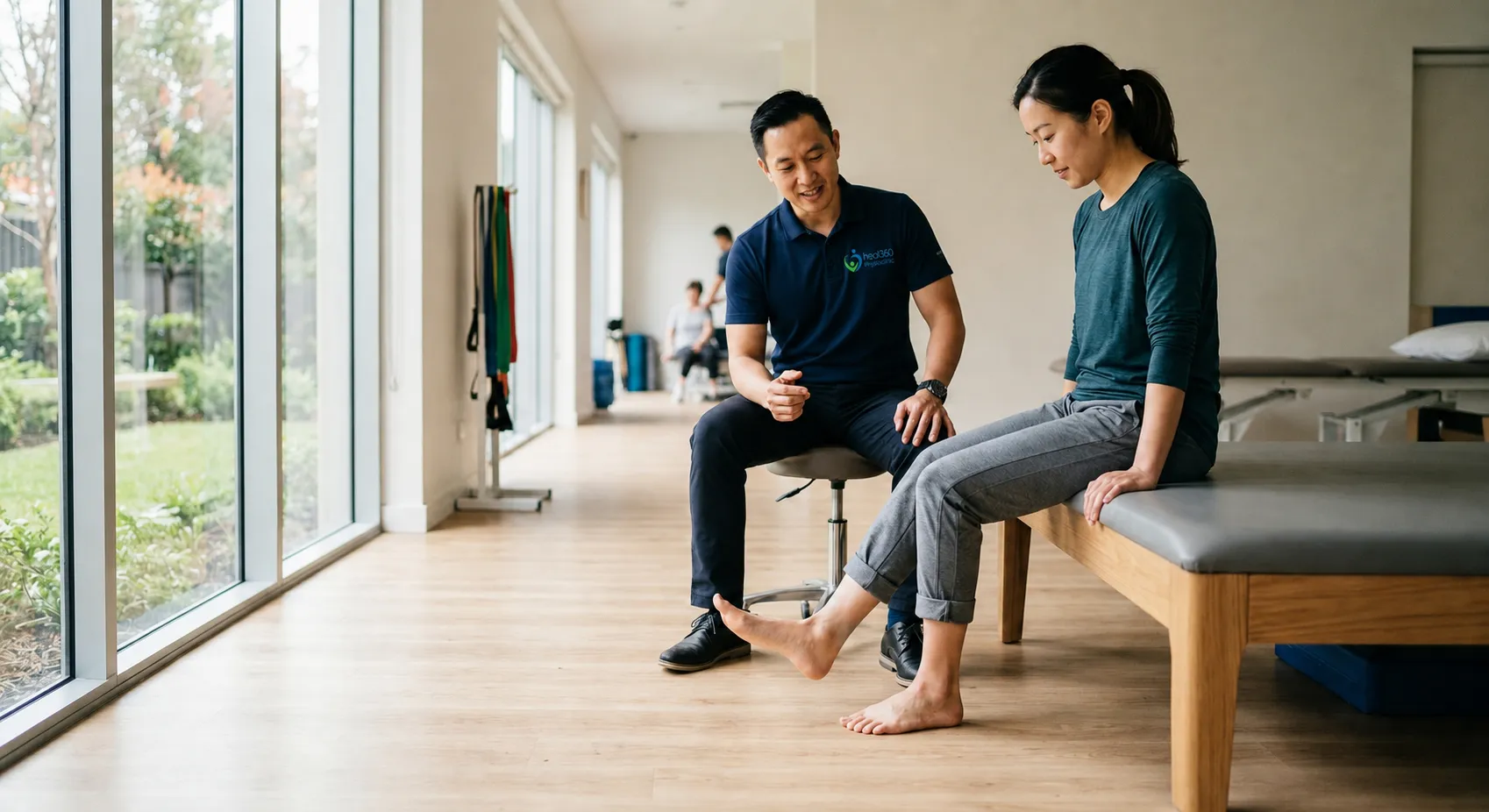
Ankle sprain or repeated rolling
A recent sprain, or an ankle that keeps giving way when you walk, change direction, or return to sport.
See sports injury rehabilitationFoot & Ankle Pain Treatment
Foot or ankle pain can affect every step. Assessment and progressive rehabilitation can help you understand what to load, what to modify, and how to work towards daily or active goals.

Common reasons people book
These cards group sprain, overload, and post-procedure situations. They are not a diagnosis.
A recent sprain, or an ankle that keeps giving way when you walk, change direction, or return to sport.
See sports injury rehabilitationPain with standing, walking, or the first steps of the day, including Achilles tendon pain.
See physiotherapyStiffness, weakness, or swelling after immobilisation, ligament repair, fixation, reconstruction, or foot surgery.
See post-surgery rehabilitationFoot or ankle pain can involve different contributing factors. Pain with standing, walking, or sport does not always identify one particular cause.
That is why we start with assessment rather than a generic rest-and-ice plan. Your physiotherapist considers how the symptoms began, what aggravates or eases them, and the walking, standing, footwear, and sport demands that matter to you.
How physiotherapy may help
Your goal might be walking without guarding the next step, standing through a workday, returning from a sprain, or getting back to running. The plan is shaped around those tasks, not a generic protocol.
After surgery or a fracture
The timing of walking and exercise must follow medical or surgical instructions, not a generic plan.
Bring any imaging report, discharge instructions, brace or boot guidance, and rehabilitation protocol. Your physiotherapist will work within those limits.
A physiotherapist will assess you, explain what they find, and shape a plan around walking, sport, or daily activity that foot or ankle pain is interrupting.
B.App.Sc (Physiotherapy), University of Sydney
Michelle has worked in both public and private care settings in Singapore, including Changi General Hospital and Singapore Armed Forces physiotherapy centres.
Locations: Tanjong Pagar, East Coast
Michelle, 1 of 3
“I have been to many physios over the years and must say that Physioclinic’s ability to diagnose my injury was superb. My plantar fasciitis injury improved almost immediately after the first treatment which allowed me to start walking without much pain. The friendly staff and the love in the way they do about their work ensuring that their patients cure, cared for properly. In particular my therapist Jo Ann, who constantly reminded me on what I need to do to improve to running and play soccer again. Physioclinic is definitely a place to go to treat any injury as they have a systematic programme to ensure that you are back to your best in the shortest period of time. Jo Ann treatment of my plantar injury has now allowed to play football again after only 4 sessions, a desparate go to person for any injury!!!”
Interkhab Khan, 1 of 6
If surgery, sport, or later-life walking is a large part of the picture, these pathways give more specific context. This page already covers physiotherapy for foot and ankle pain.
Choose this pathway when you are recovering after ligament repair, fixation, reconstruction, or foot surgery.
Explore post-surgery rehabilitationChoose this pathway when running, change of direction, or sport-specific loading is the goal you want back.
Explore sports injury rehabilitationChoose this pathway when walking, standing, or independence in later life is the main need.
Explore elderly rehabilitationThese pages cover other common concerns. They are navigation links, not a list of conditions that usually occur together.
Pain, weakness, or uncertainty about loading the knee or leg.
Explore knee and leg careJoint stiffness and everyday mobility when arthritis is part of the picture.
Explore arthritis careIt depends on the injury, severity, and medical instructions. If you cannot bear weight after an injury, have significant deformity, or symptoms are severe, seek prompt medical assessment.
Rehabilitation may address strength, balance, control, confidence, and the demands of your activity. The plan should be based on an assessment rather than a generic set of exercises.
Footwear can matter, but it is rarely the only factor. Your physiotherapist can discuss whether footwear advice, another professional assessment, or other changes are relevant.
heal360 Physioclinic is at Tanjong Pagar and East Coast. Both clinics are by appointment only. Book online, or ask which location is more convenient.
Email info@physioclinic.sg if you are unsure which appointment to book.
Book a foot and ankle assessment at Tanjong Pagar or East Coast, or ask the clinic which appointment is most suitable.