
Skip to content

Treatments & Rehab

Want to get back to your sport without guessing?

Whether you train hard, go to the gym, or play on weekends, we look at the movements your sport actually needs—not only the sore spot.

By appointment only at Tanjong Pagar and East Coast.

Is this what you are dealing with?

  • Muscle strains and ligament sprains
  • Tendon-related pain that appears during or after training
  • Shoulder, knee, ankle, hip, or back symptoms during sport
  • Reduced confidence after an injury
  • Symptoms that return as training volume or intensity increases
  • Guidance on returning to running, gym, field, court, or recreational play

What we look at during your assessment

  1. 1

    Your sport and training

    We ask what you play or train, how often, and what you want to get back to—not only where it hurts.

  2. 2

    How you are moving now

    We look at strength, mobility, balance, and the movements your sport uses, plus recent changes in training.

  3. 3

    A staged way back

    Feeling better is a good start, but it may not mean you are ready for a full session. We build up in stages towards the activity you care about.

During the appointment we may look at

  • How you currently train — distance, speed, surface, and hills
  • Strength and control in the movements your sport needs
  • A graded return, rather than rest as the whole plan

How we help you return safely

Feeling better matters, but it may not mean you are ready for every drill or match. We usually build from easy daily movement, to controlled exercise, to sport-specific practice, then back into training. How fast that happens depends on the injury, the sport, and you.

Pain settled. The first faster session brought it back.

A recreational runner after a calf strain

Two quiet weeks made walking comfortable again. The first attempt at usual pace brought the tightness back within a kilometre. That pattern is common: daily movement had recovered, but the load of training had not. An assessment would look at recent training, calf and lower-limb capacity, and how to rebuild speed without treating rest as the whole plan.

This is an illustrative example. It is not a patient story or testimonial, and it does not predict your outcome.

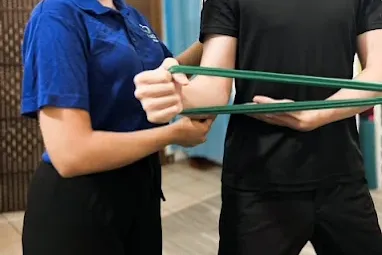
Physiotherapist guiding a patient through a resistance-band exercise.
A runner who is pain-free during daily activities may still struggle when mileage, speed or hills increase. We look at those actual training demands before planning the return.

Physiotherapist at heal360 Physioclinic

Sports-injury rehabilitation with an experienced physiotherapy team

A physiotherapist will assess you, explain what they find, and shape a plan around the training or competition load you want to return to.

Michelle

  • Principal Physiotherapist

B.App.Sc (Physiotherapy), University of Sydney

Michelle has worked in both public and private care settings in Singapore, including Changi General Hospital and Singapore Armed Forces physiotherapy centres.

  • Chronic pain and movement confidence
  • Musculoskeletal conditions such as neck, back, shoulder, and knee symptoms

Locations: Tanjong Pagar, East Coast

Michelle, 1 of 4

“To the large extent felt looser and more nimble after training and fight. Therapist is meticulous and friendly. I would definitely recommend Physioclinic to anyone.”
Juan We Jie, Singapore MMA Champion of ONE FC

Juan We Jie, Singapore MMA Champion of ONE FC, 1 of 6

We follow your surgeon’s instructions first

When an operation is the starting point, use the post-surgery pathway and bring any protocol you have.

Post-Surgery Rehabilitation

Two clinics in Singapore

heal360 Physioclinic is at Tanjong Pagar and East Coast. Both clinics are by appointment only. Book online, or ask which location is more convenient.

Email info@physioclinic.sg if you are unsure which appointment to book.

Questions people often ask

Do I need to stop my sport completely?

Not always. Depending on the injury and risk, training may be modified while rehabilitation addresses the limiting factors. Some presentations require rest, protection, or medical review first.

Can physiotherapy help if the pain only appears during training?

An assessment can consider the specific movement, intensity, volume, and recovery pattern that brings on symptoms. Bring videos or training information if requested and appropriate.

Is sports rehabilitation only for competitive athletes?

No. The same principles can support recreational runners, gym users, dancers, weekend players, and anyone returning to an activity they value.

How do you decide when I can return?

Feeling better is one part of the picture. Progress is reviewed against the demands of your sport. There is no single date or test that can eliminate the risk of another injury.

Tell us what you want to get back to

Book an assessment. We will ask what you play or train, what currently stops you, and what a usual week looks like.